
Assess and Assist Features Analysis
Apple Hearing Study Results Highlight the Importance of Apple Hearing Test and Hearing Aid Features
The Apple Hearing Study, a collaboration between the University of Michigan and Apple, is a study of over 160,000 consented participants in the United States. Since 2019, results from this study have enabled novel scientific insights into noise exposure, tinnitus, and hearing loss in adults. This study also helped enable development of Apple’s Hearing Test and Hearing Aid features that were released in 2024 and are now available in over 150 countries and regions around the world.
Apple developed these features because of our growing public health understanding of the importance of hearing to health across the life course. Hearing is a foundational sense for the brain that supports our cognitive, physical, and social functioning. However, individuals are often unaware of their actual hearing status given that hearing loss comes on slowly and many individuals may often attribute any perceived hearing difficulties to others not speaking clearly rather than changes to their own hearing abilities. This underscores the need for scalable solutions such as Apple’s Hearing Test and Hearing Aid features that allow for users to objectively monitor hearing and address hearing loss over the life course.
In this report, we provide unique insights from the Apple Hearing Study on the importance of individuals’ monitoring their hearing using numeric results rather than simply thinking about whether their hearing is “normal”. Hearing is typically measured using the four-frequency pure tone average (4PTA), which indicates the softest level of sound that a person can hear at frequencies of 500, 1000, 2000, and 4000 Hz. These frequencies are important for understanding speech. Classification is based on guidelines from authorities like the World Health Organization (WHO) and is traditionally defined as normal hearing ≤ 25 dB, mild hearing loss 26-40 dB, moderate hearing loss 41-60 dB, severe hearing loss 61-80 dB, and profound hearing loss as ≥ 81 dB. Many times, when an individual’s results are ≤ 25 dB, they are simply told their results are “normal”; however significant variability in individuals’ experience with hearing exists within this category. Enabling individuals to track and monitor their actual 4PTA values, similar to how people track their blood pressure and other health metrics, may allow individuals to better understand and take earlier action on their hearing health.
This report also provides insights into the adverse effects that hearing loss may have on mobility and physical health. While increasing evidence over the past decade demonstrates the adverse impact that hearing loss can have on cognitive and brain health (1), less has been known about the potential effects of hearing loss on our mobility and physical health. For instance, poorer hearing could affect walking speed through making it harder to hear environmental sound cues like the sounds of foot falls and traffic noise, which give individuals information about their physical environment. In this report, we evaluate the connection between walking speed and hearing status. Aside from a direct mobility measure, walking speed is also an important indicator of overall health status, as it relies on coordination across the brain, heart, lungs, muscles, as well as vision and hearing systems (2). The impact that hearing loss may have on mobility and physical health highlights the potential importance of identifying and managing hearing loss through actions such as use of the Apple Hearing Test and Aid Features.
Understanding and Measuring Hearing
What We Did
To understand the variability in self-reported hearing ability and difficulty among those with “normal” hearing per 4PTA, we analyzed data collected between November 17th, 2019, and November 30th, 2025 on 84,970 participants of the Apple Hearing Study who had complete data for both values. The analysis was restricted to those classified as having normal hearing based on the WHO classification (4PTA in the better-hearing ear ≤ 25 dB). Self-reported hearing ability was described as excellent, very good, good, fair, or poor. Self-reported hearing difficulty in daily life was evaluated using two questions: 1) degree of difficulty with having to concentrate when listening to someone (‘concentration’), and 2) degree of difficulty with hearing during a conversation when others are talking in the same room (‘conversation’).
What We Found
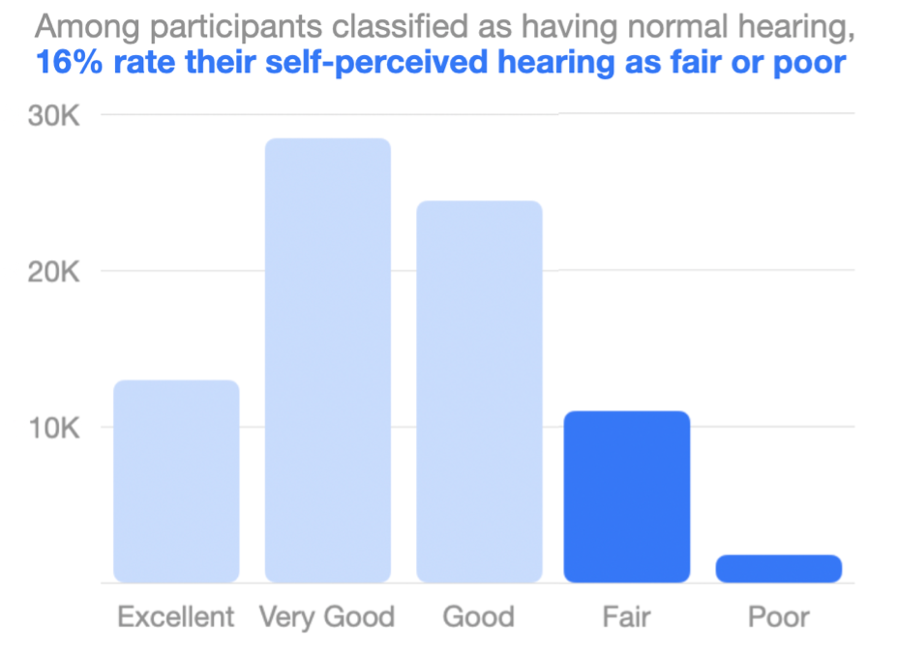
Among individuals classified as having normal hearing, self-reported hearing ability varied widely. More than 16% of these participants rated their hearing as fair or poor (Figure 1) despite having a level of hearing considered clinically to be normal.
Figure 1: Hearing Ability - Distribution of self-perceived hearing ability for participants classified as normal hearing
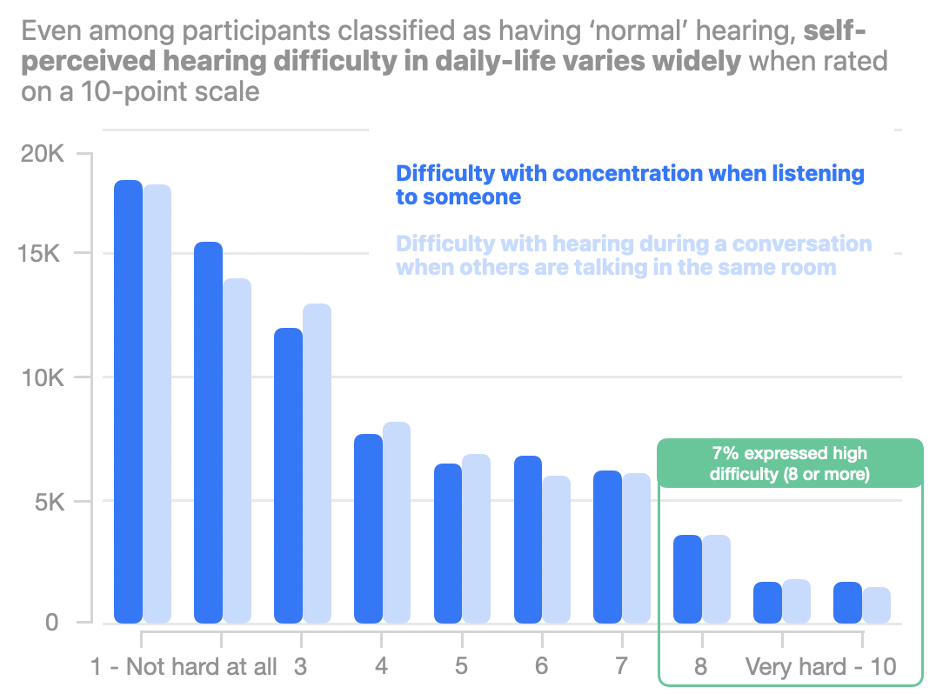
Further illustrating the gap between measured and perceived hearing ability among individuals classified as having normal hearing, many participants classified as having normal hearing reported difficulties with concentration when listening to someone and when understanding others with background speakers, as noted in figure 2. More than 7% of these participants rated the difficulty score larger than or equal to 8 (1 = not hard at all, 10 = very hard).
Figure 2: Hearing Difficulty - Distribution of daily-life hearing difficulty for participants classified as normal hearing
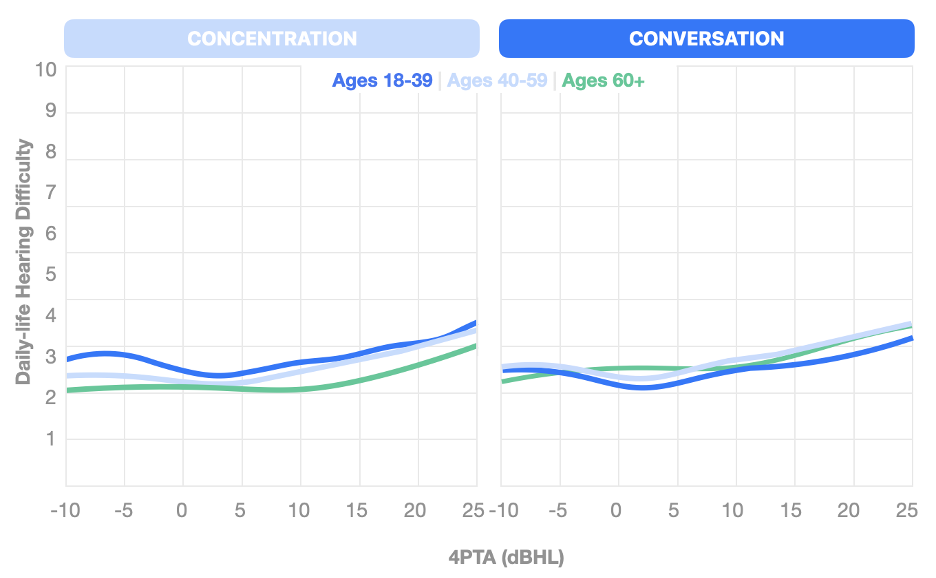
Although variability is present, self-reported hearing ability (Figure 3) and self-reported difficulty with conversational abilities (Figure 4) tracked closely with individuals’ 4PTA hearing numbers. After accounting for age and sex (not shown), we found that the 4PTA was strongly and significantly associated with self-perceived hearing ability (p<.001) and with daily life hearing difficulties (p<.001).
Figure 3: 4PTA across self-perceived hearing ability categories for participants classified as having normal hearing
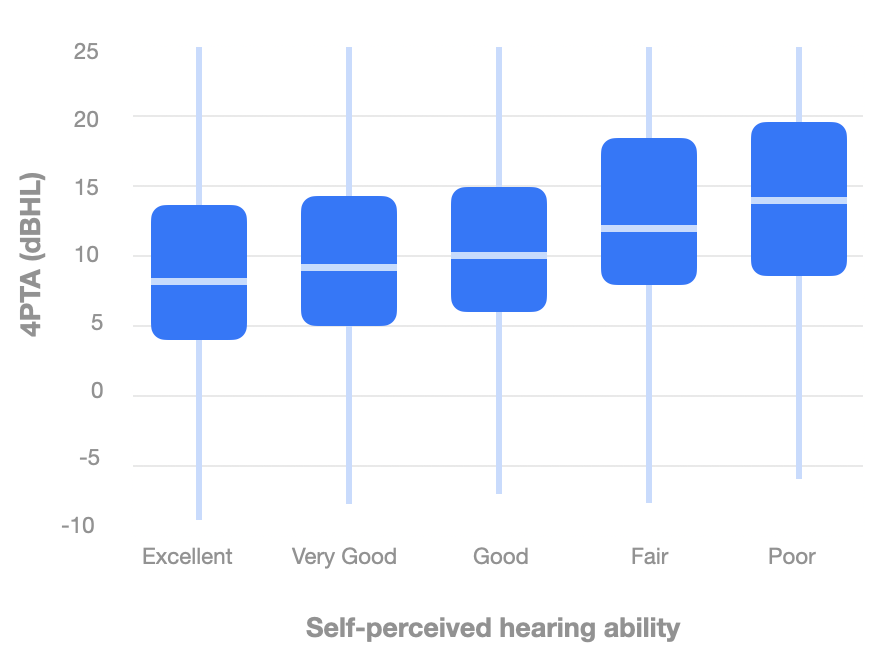
Figure 4: Daily-life hearing difficulty as a function of 4PTA for participants classified as having normal hearing (1 = not hard at all, 10 = very hard)
Hearing and Mobility
What We Did
To understand potential effects of hearing loss on mobility and physical function, we also analyzed data from 57,183 individuals who had 4PTA measures and walking speed data, which is passively measured using sensors on iPhone (3). Among individuals with at least 30 days of walking speed measurements, an individual’s walking speed was defined by the average of all available walking speed measurements taken up to 1 year before and 1 year after when an individual performed a hearing test. Unlike walking speed measurements that are typically measured under specific clinical conditions (e.g., recorded as a person walks at their usual pace in a hallway), iPhone walking speed measurements reflect the average of an individual’s actual walking speed in everyday real-world environments whenever an individual is walking with their iPhone.
What We Found
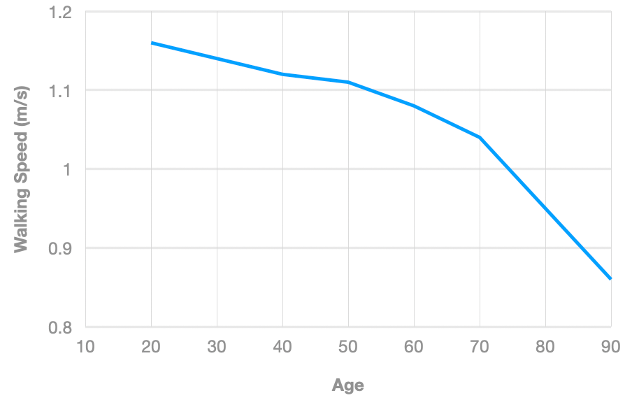
We found that walking speed (measured in meter per second) varied across individuals and tended to decrease with age (Figure 5) consistent with prior research (2).
Figure 5: Walking speed as a function of age
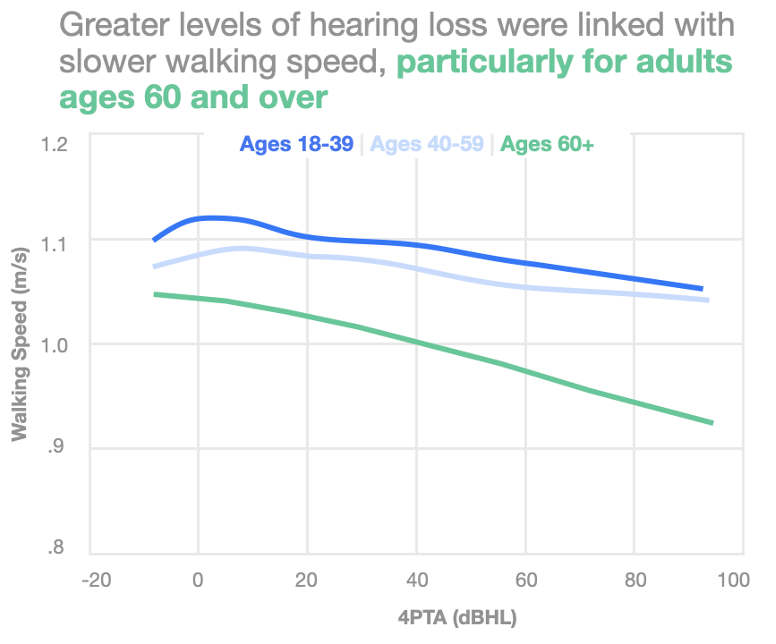
When looking at hearing as measured by the 4PTA, we found that greater levels of hearing loss were also linked with slower walking speed (Figure 6), particularly for adults ≥ 60 years, and these results persisted even after accounting for age and sex (p<.001; not shown).
Figure 6: Walking speed as a function of 4PTA
The Bottom Line
We found that the hearing metric we evaluated, 4PTA, was associated with self-reported hearing ability and with daily-life hearing difficulty among people classified as having normal hearing. Enabling individuals to monitor their hearing using the 4PTA, which they can do using Apple’s Hearing Test Feature, gives them the opportunity to track their hearing as it changes over time, even when classified as clinically normal, and to take steps to protect and assist their hearing over their lifetime. We also found that increasing hearing loss was strongly linked with lower walking speed that is a key indicator of mobility and physical health. Addressing and treating hearing loss with strategies such as the Hearing Aid Feature may help promote physical health over the life course. Importantly, none of these findings would have been possible without the help of the participants of the Apple Hearing Study.
References
- World report on hearing. Geneva: World Health Organization; 2021. Licence: CC BY-NC-SA 3.0 IGO.
- Studenski S, Perera S, Patel K, et al. Gait Speed and Survival in Older Adults. JAMA. 2011;305(1):50–58. doi:10.1001/jama.2010.1923
- https://www.apple.com/healthcare/docs/site/Measuring_Walking_Quality_Through_iPhone_Mobility_Metrics.pdf