Faculty Results

A light blue rectangle with 58 generic dark blue people logos—one row across the top and two rows of four on either side—with the words WORLD'S (in white) TOP 2% (in yellow) SCIENTISTS (in white) centered above a white sketch of earth with black outlines of the continents

Michigan Public Health faculty rank among most cited researchers

University of Michigan School of Public Health celebrates global research impact as a citation study names 58 faculty among the world’s top 2% most cited scientists. Recognized across all six departments, Michigan Public Health pairs interdisciplinary expertise with real-world solutions, national No. 4 ranking, and six faculty in the top 0.1% worldwide.


Two photos of Melissa Creary, one with her looking to the left and one straight with graphic elements of red sickle cells

The weight of knowledge

How living with sickle cell shapes Melissa Creary’s mission for health justice

Melissa Creary, associate professor of Health Behavior & Health Equity and Global Public Health, turns a delayed childhood sickle cell diagnosis into two decades of science, policy and advocacy. From building CDC surveillance to researching racism and “bounded justice” in Brazil, she centers lived experience and community voices—insisting innovation like gene editing must deliver equity, not stigma.

Jennifer Garner as a youth in the family garden

Science rooted in community

How Jennifer Garner’s upbringing drives her nutrition research

Jennifer Garner, the John G. Searle Assistant Professor of Nutritional Sciences, reflects on growing up in rural Michigan, learning “strategically applied stubbornness” from her parents, and finding an unexpected path from dietetics to academia. Through mentorship and community-based research, she builds a career in food security, policy and science communication—grounded in care, curiosity and purpose.

Interim Dean Lynda Lisabeth

Why we choose public health

How witnessing hardship guides purpose, and how students and faculty turn resolve into action: Why people choose public health often highlights community, equity, and the drive to improve systems that fail people—encouraging prospective students to remember their “why” and keep building change.

An animated gif of a robot throwing donots and then getting hit in the face with an apple

Game on

Transforming smartphones into health-boosting tools

What if the power behind the programs that keep us leashed to our devices actually delivered good health, disease prevention—even digital vaccinations? Rahul Ladhania, assistant professor of Health Informatics, Biostatistics and Health Management & Policy at Michigan Public Health, is part of a team of global researchers doing the painstaking work of subverting the formidable powers of computer algorithms into a force for good.

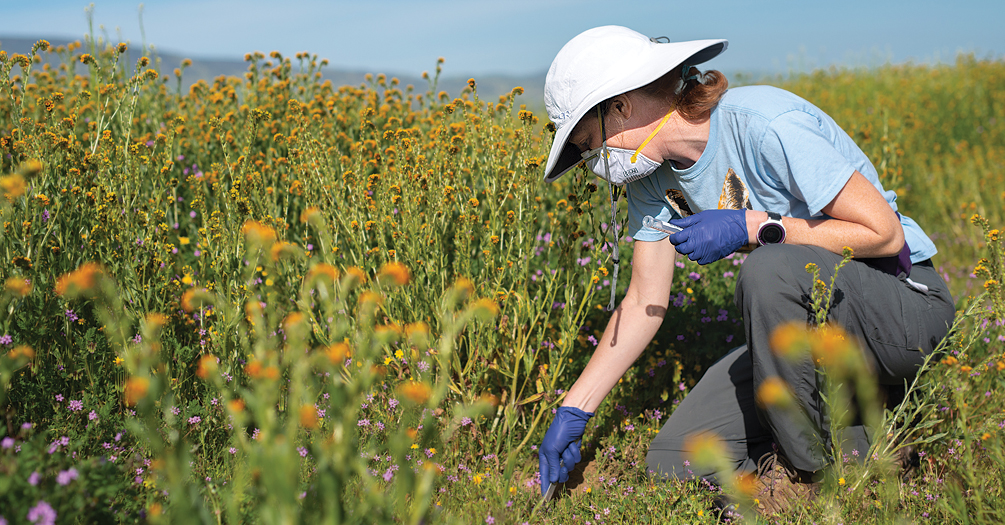
Jennifer Head in a field with protective mask and gloves

The first line of defense

Investigating the spread of fungal infections due to climate change

Fungal pathogens are often somewhat of an apparition, an unexpected and seemingly invisible opponent of good health, until they are exposed under a laboratory lens or on a chest X-ray. Jennifer Head is helping to compose the book on understanding these potent vectors of disease, which sometimes can be misdiagnosed as pneumonia, tuberculosis or cancer.