Leading global impact through science, partnership and innovation
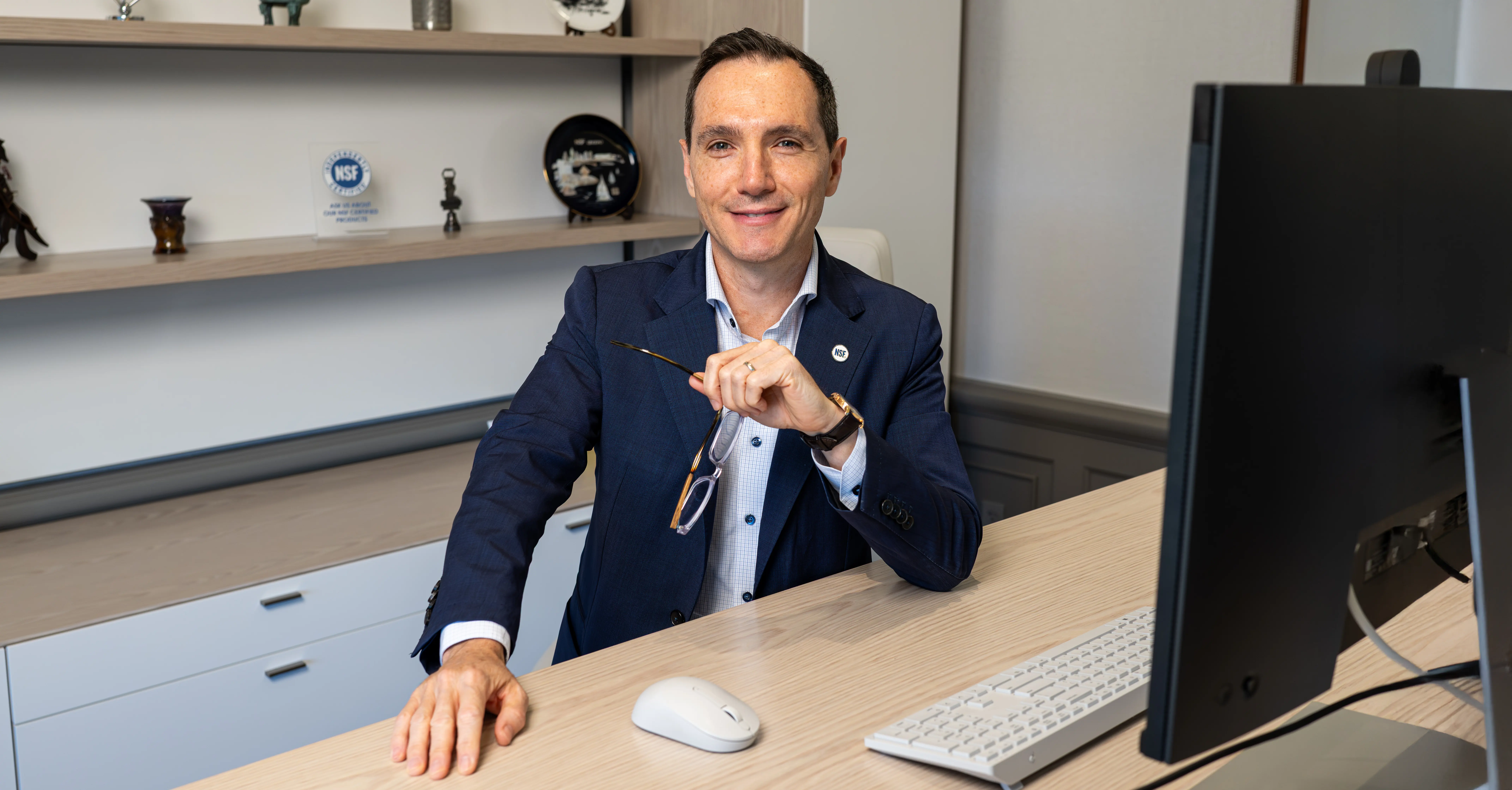
Q&A with Pedro Sancha, President and CEO of NSF
Michigan Public Health Dean’s Advisory Board member
By Bob Cunningham
A global partnership born in Ann Arbor now reaches across 110 countries, providing science-based standards that shape how the world keeps food and water safe.
What started as the National Sanitation Foundation (NSF) in the University of Michigan School of Public Health’s basement in 1944 has grown into a global company employing 5,000 experts who serve 40,000 clients, influencing health outcomes at every turn.
Today, NSF’s connection to Michigan Public Health remains central to its mission, fueling research and innovation that improves lives around the world.
Pedro Sancha is NSF’s President and CEO, and also serves on the Dean’s Advisory Board at Michigan Public Health. He recently discussed the organization’s expanding role in global public health, the importance of its partnership with Michigan Public Health, and the future of science-driven solutions.
When you first arrived at NSF, what were your initial impressions of the organization, both its strengths and areas of opportunity?
Coming to NSF, I was immediately struck by two things: the world-class expertise and dedication of the people, and the depth of purpose guiding every action. NSF had built a reputation as a trusted, expert authority in public health—yet most people didn’t realize how deeply our work shaped everyday life. From the water people drink to the supplements they take to the way food is prepared in restaurants, you can find NSF everywhere it matters. I saw an enormous opportunity to unlock even more impact by making our mission visible and expanding our expertise globally. My priority was to preserve that legacy while also helping the team think bigger and innovate faster.
NSF uses the term “High Purpose, High Performance” (HP2) to describe its culture. What does that mean day-to-day, and why is it important for public health work?
For us, HP2 is not just a slogan—it’s our operating system. High Purpose means we always put human health and safety first; it's our compass and foundation. High Performance means delivering on that purpose with urgency, accountability and measurable impact. In practice, it shows up as collaboration across teams, exceptional client service, an openness to innovate and a commitment to excellence in everything we do. When one of our scientists finds a contaminant in a water system, it’s not just about reporting results, it’s about mobilizing action to protect people, wherever they live. That’s the drive we instill at every level.
You mentioned that NSF is now a truly international organization. What does that global perspective bring to your work—and what challenges come with operating on so many continents?
We serve clients in more than 110 countries, which means our team must bridge not just languages and regulations, but also cultural expectations around health and safety.
While NSF originated in the US, we operate locally. Many of our activities and team members are outside of the US. To be global, you need to be local. We call it the “glocal” approach, and it applies both to how we operate and our talent strategy. Risks are often context-dependent, and you need local insights to understand them. Also, there are cultural and regulatory reasons that require us to adapt our programs and services to drive adoption locally.
We flex our approach to the markets we serve and build strong local teams that are close to our clients. Proof in point, we expanded our global network of laboratories with the opening of our state-of-the-art water lab in Germany and the investment in a greenfield lab in China. We also strengthened our footprint with new offices in Belgium, Mexico, Costa Rica, Chile, India, Thailand, Romania, Dubai and Taiwan.
The global breadth of NSF means we’re constantly learning: how to apply science in local situations, how to adapt to emerging health risks, and how to work with governments and communities to build trust. One of our biggest strengths is diversity—our experts are from everywhere, and their insights help NSF innovate and respond quickly. Staying agile amid rapid change—whether it’s a new contaminant, regulatory shift, or industry change—is what we do, and science is always our anchor.
How does NSF identify and respond to new and emerging public health threats? Can you describe a recent example?
Our work involves working on a daily basis with more than 40,000 clients, who are the biggest manufacturers and retailers of food, water and wellness products. We also partner with regulatory bodies and academic institutions like the University of Michigan to conduct research and constantly scan the horizon for signals—from new chemicals in the environment to shifts in food manufacturing to changes in consumer behavior. PFAS chemicals, for instance, have made headlines for their persistence and potential health impacts. NSF partnered with leading universities and health agencies to develop testing protocols and certification standards for water filters that can remove these “forever chemicals.” Another example is our work on microplastics, which are increasingly found in water supplies worldwide; we’re helping set benchmarks for detection and mitigation. We combine laboratory expertise with field testing, and turn findings into consensus standards that raise the bar for everyone. Then, we work with the industry to drive compliance and provide third-party verification against those standards.
NSF has a unique partnership with Michigan Public Health, from research collaborations to scholarships. What does that partnership mean to you personally?
I find the Michigan Public Health connection both inspiring and grounding. There’s a deep sense of continuity—from the founders in that basement to today’s students and researchers solving 21st century problems. The partnership is a pipeline for talent, for new questions and insights. For me, it’s also personal: I see how access and opportunity—through scholarships and research projects—change lives. Swati Sriram’s journey, for example, shows what happens when an organization invests in students and then welcomes them as colleagues. NSF’s partnership with Michigan Public Health is a two-way street: We benefit from their research, and they shape our evolving standards. It’s the kind of collaboration that multiplies value, not just for our organizations, but for society at large.
The story in Findings about the support of international students and the Department of Environmental Health Sciences touches on NSF’s efforts to “predict and prevent” health risks, rather than merely audit or react. How is technology—like AI and data analytics—changing public health standards?
Technology brings us from reactive to proactive. For decades, the industry would wait until something went wrong—a foodborne illness outbreak, water contamination—then rush to investigate. Now, with powerful data platforms, we can analyze patterns from hundreds of thousands of audits and millions of data points to spot risks before they escalate. For example, if data shows certain restaurants or water systems are more likely to have non-conformities, we can intervene early, helping prevent allergen contamination or harmful chemical exposure. Artificial intelligence accelerates this work by finding connections we would otherwise miss. The future is predictive public health, where we use information not just to fix, but to prevent, and ultimately to educate.
What do you see as the biggest challenges for public health today—especially as science intersects with misinformation and shifting public beliefs?
The biggest challenge is keeping science at the heart of decision-making, especially as misinformation spreads faster than ever. Social media and technology have changed the way people learn about health—sometimes for the better, but often with unintended consequences. We see young people increasingly confident in their health knowledge yet sometimes disconnected from the expertise that comes from rigorous study. At NSF, our role is to provide trustworthy information, set standards, and help guide choices based on scientific evidence, not algorithms. The partnership with Michigan Public Health is vital here because they bring the latest research and help us communicate findings in ways that resonate.
Can you share a moment from your leadership at NSF that best illustrates the company’s values?
One moment that stands out is during the COVID-19 pandemic. Our teams in Asia and Europe moved swiftly to develop rapid response protocols for sanitizing surfaces, improving ventilation, and verifying food safety—in real time as regulations and science evolved. There was no playbook, but NSF’s mission was clear: Protect people and minimize risk. Teams collaborated across borders, time zones and languages, united by a shared mission. That solidarity and sense of purpose fueled rapid innovation. We were reminded that public health does not pause in a crisis; our values give us the resilience to respond.
Looking forward, what excites you most about NSF’s future—and its partnership with Michigan Public Health?
I’m energized by the potential to shape the next chapter in global human health. The problems are bigger, the urgency greater, but the solutions are within reach if we keep fostering partnerships across the public and private sector, and leverage digital innovation. NSF and Michigan are advancing fields like environmental toxicology, food and nutrition science, and data-driven health protection together. What excites me most is the possibility to create lasting impact—not just for today’s consumers, but for generations to come. The story that started in Ann Arbor continues to expand, and I see limitless opportunities to lift each other further.