
A global partnership born in Ann Arbor
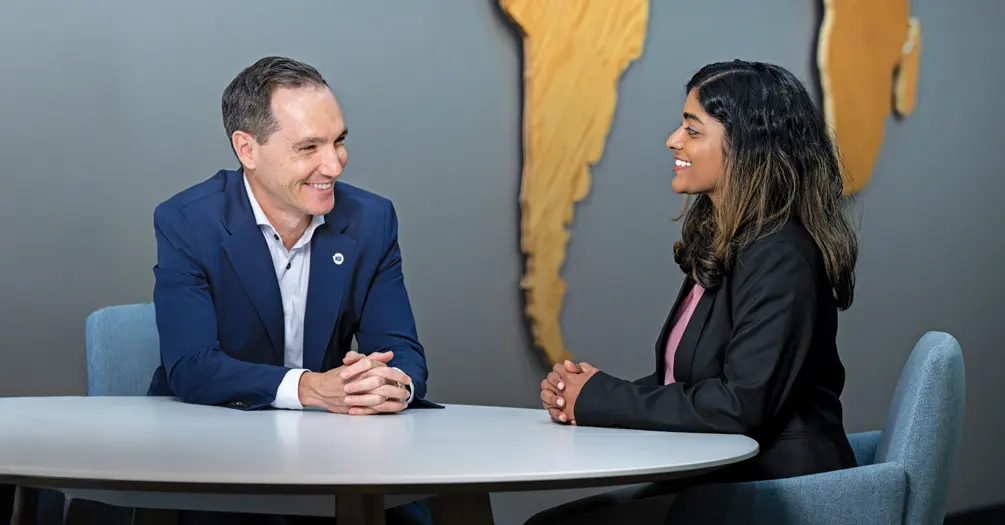
How NSF’s connection with Michigan Public Health transforms lives around the world
By Bob Cunningham
Photos by Andrew Mascharka
In a basement beneath the University of Michigan School of Public Health in 1944, three scientists—Henry Vaughan, Nathan Sinai and Walter Snyder—had a vision that would change public health forever.
As World War II was ending and Americans were beginning to socialize in restaurants again, these researchers saw a critical need to develop science-based standards to keep food and water safe and established the National Sanitation Foundation (NSF).
More than 80 years later, that basement startup has grown into NSF, a global company with 5,000 experts serving 40,000 clients in 110 countries—the trusted authority for health standards, testing, certification, consulting and training for food, water and wellness products. But the connection to Michigan Public Health remains stronger than ever—and it’s changing lives around the world.
From basement to boardroom
Pedro Sancha, President and CEO of NSF, calls his organization “the most important company you’ve never heard of.” That’s because NSF works behind the scenes, testing products and auditing facilities to protect public health. When you grab a vitamin supplement or fill a water bottle at a hotel, chances are NSF has certified it.
“We’re checking that your grocery store is following the right procedures, that your restaurant has been audited, that the water from source to tap is clean,” Sancha said. “Until you know NSF, you’re not necessarily aware of the impact we have.”
Sancha, who became CEO of NSF in February 2022, brought a fresh perspective as the first leader hired from outside the company and the first not born in the United States. Originally from Spain, he grew up speaking French and Arabic in Africa before moving through Europe, Asia and eventually to Michigan.
“When I was appointed CEO, I learned about the organization’s incredible contributions to public health,” he said. “It felt like I was standing on the shoulders of giants—our founders, thousands of team members, scientists and partners who built that incredible legacy.”
Under Sancha’s leadership, NSF has undergone what he calls a transformation into a “High Purpose, High Performance” organization—or “HP2.” The company has expanded globally, with more than 50% of revenue now coming from outside North America. It’s also branched into new areas such as sustainability audits and cybersecurity.
“We’ve gone from three scientists to 5,000 experts,” Sancha said. “In a given year, we conduct 300,000 audits and test more than 600,000 products in our laboratories.”
PROSPECTIVE STUDENT? Learn more about Michigan Public Health.

The science behind the mission
What makes NSF’s approach unique traces back to those original Michigan founders who understood that “public health is a team sport.” They brought together regulators, manufacturers, consumer advocates and scientists to develop consensus standards—a collaborative approach that remains central to both NSF and Michigan Public Health today.
“That approach of mixing science, research and partnership is very much at the center of how we operate,” Sancha said. “It’s pretty much in our roots.”
This philosophy drives NSF’s continued investment in emerging public health challenges. The company is tackling new threats like PFAS (forever chemicals) and microplastics in water systems, contaminants from food packaging, and the health impacts of ultra-processed foods.
“We have to continually push the boundaries of science and tackle emerging risks to human health,” said Sancha, describing himself as the company’s “chief optimist.” “Whether it’s understanding the impact of ultra-processed foods or contaminants migrating from food packaging into food, there’s a big role for us to continue raising standards.”

A chair that connects two worlds
The partnership between NSF and Michigan Public Health takes concrete form through the NSF Chair of Environmental Health Sciences, currently held by Dana Dolinoy. For Dolinoy, the endowed chair provides both financial support and something equally valuable: a platform to educate people about NSF’s work.
“Everyone asks, ‘What’s the NSF Chair?” Dolinoy said. “It always gives me an opportunity to tell everybody what a great organization it is.”
NSF was definitely a major driver toward me choosing the University of Michigan. They planted the seed to help me start my career with public health.”
— Swati Sriram, MPH ’23
The chair funding provides tremendous flexibility, allowing Dolinoy to support student scholarships, upgrade classroom technology, and foster research collaborations. Students now use real-time sensors in their laboratory courses and conduct research analyzing chemicals in population-based cohorts, then send samples to NSF laboratories for more detailed analysis.
“It’s a really nice feedback loop,” Dolinoy said. “Students learn with updated equipment, then we collaborate with NSF to measure chemicals like PFAS in our research samples.”
The partnership extends beyond the classroom into cutting-edge research. Dolinoy’s laboratory studies how environmental exposures affect health through epigenetics—changes that happen outside the genome. NSF’s sophisticated laboratories serve as an extension of Michigan’s research facilities.
“Being able to just collaborate across town in research is a really big advantage,” Dolinoy said. “We can do the most rigorous science.”
READ MORE about faculty, students, alumni and staff.

From scholarship to success
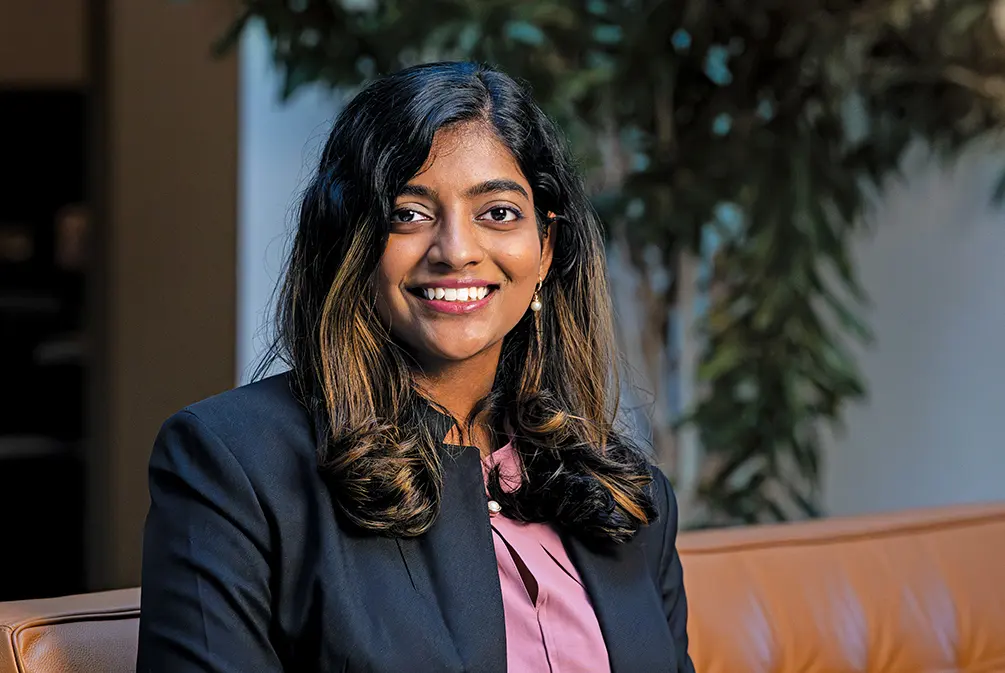
The human impact of this partnership comes alive in stories like those of Swati Sriram. The 2023 graduate from Chennai, India, embodies what Sancha calls NSF’s investment in “world-class talent.”
Sriram received the NSF Global Scholarship, which covered 50% of her tuition and made receiving a Life-Changing Education at Michigan Public Health possible.
“NSF was definitely a major driver toward me choosing the University of Michigan,” she said. “They planted the seed to help me start my career with public health.”
During her studies, Sriram worked in Dolinoy’s laboratory researching piRNA, a specialized molecule involved in gene regulation. Her expertise was rare—she had co-authored a research paper on the topic during her undergraduate studies in India.
When I was appointed CEO, I learned about the organization’s incredible contributions to public health. It felt like I was standing on the shoulders of giants—our founders, thousands of team members, scientists and partners who built that incredible legacy.”
— Pedro Sancha, President and CEO of NSF
“The moment I came across piRNA research at Michigan, I said, ‘Yes, I have to contact Dr. Dolinoy,’” Sriram said. “They were impressed by the fact that I knew what piRNA was because it was a very novel topic.”
After graduating with a Master of Public Health in Environmental Health Sciences, Sriram worked in environmental consulting but faced job loss earlier this year due to industry changes. As an international employee, visa requirements made finding new work urgent. Through her Michigan connections, she reached out to NSF—and the partnership came full circle.
“It feels amazing because every achievement that I’ve had so far, I sort of owe back to NSF because they planted the seed,” Sriram said.
In September, she started working at NSF as an Associate Consultant in Toxicology.
“For me, it’s very important to be able to work for an organization that really sticks true to its core values of wanting to create equitable health solutions to complex human health and environmental problems,” Sriram said.
Global scholars, global impact
Today’s NSF scholars represent the international scope of both organizations’ missions. The program, which has provided a significant investment over the past 10 years, supports students from around the world who bring diverse perspectives to public health challenges.
Farhia Mohamed from Kuwait is pursuing her MPH in Nutritional Sciences with plans to work internationally through organizations like the United Nations.
“It’s not just a scholarship; it’s an investment in a student with a vision and purpose,” she said.
Fransisca Anozie from Lagos, Nigeria, studies Health Behavior & Health Equity while working on community safety projects. The support allows her to engage fully in research without financial stress.
“I would not have been able to participate so fully in these research, community and academic initiatives,” she said.
Sydney Morales Badillo from San Juan is studying Environmental Health Sciences with a focus on Occupational Health.
“I would not have been able to attend this program without the generous support from NSF,” she said, adding that the scholarship allows her to “focus fully on my studies and professional development.”
SUPPORT research and engaged learning at Michigan Public Health.
The next chapter
As both organizations face an evolving world, their partnership continues to adapt. Sancha sees artificial intelligence and data analytics transforming NSF’s work from reactive to predictive. Instead of just auditing restaurants after problems occur, NSF aims to use data from their 300,000 annual audits to predict and prevent health risks.
“As an example, if we can predict that these restaurants are more likely to experience a salmonella outbreak in the future, we can prevent any safety violations from happening,” he said.
The opportunities ahead include combating health misinformation in the social media age.
“People between 18 and 34 believe they know more about health than their doctors,” Sancha said. “I’d love students to think about how we keep science at the center of public health and help guide folks to make sound decisions based on real expertise.”
We have to continually push the boundaries of science and tackle emerging risks to human health.”
— Pedro Sancha, who describes himself as the company’s ‘chief optimist’
For the partnership itself, Sancha envisions even closer alignment between NSF’s real-world applications and Michigan Public Health’s research.
“I hope we can continue to be a bridge,” he said. “NSF was a pioneer in public-private partnership before that expression was even popular.”
Despite global uncertainties, both leaders remain optimistic.
“We’ve worked across many administrations—we’ve seen global crises, world wars,” Sancha said. “As long as we stay focused on the science, on the mission, and keep collaborating and partnering, there’s nothing more important than public health.”
The story that began in the Michigan Public Health basement eight decades ago continues to unfold across the globe, one student, one standard, and one safer product at a time.
As Dolinoy puts it: “It’s truly a collaboration that’s lifting everybody up and forward.”